King Jimmu to Eastern Invasion
Jimmu is not, as described in myth, a founder of Japan. Jimmu  and Kume
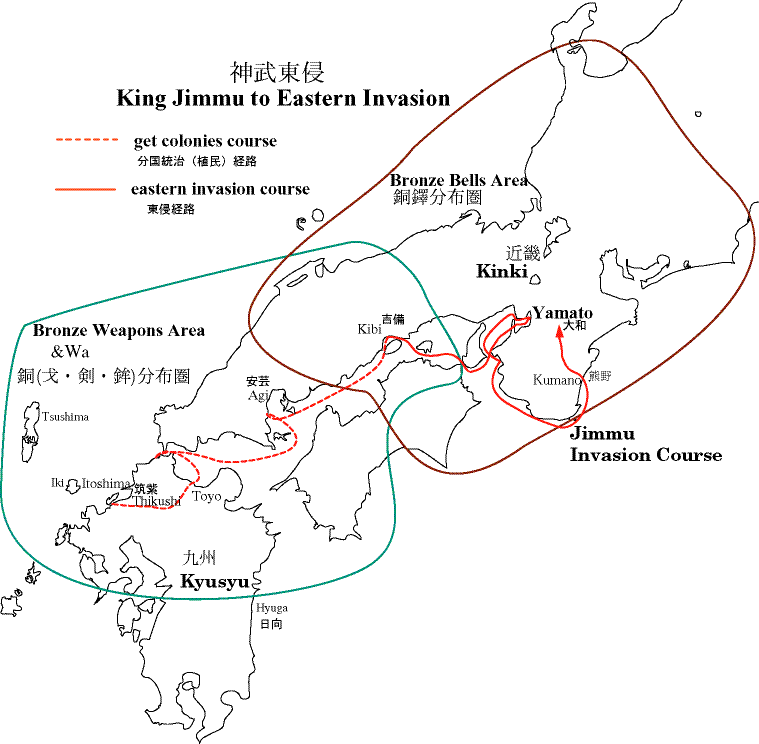
 Group attacked the Bronze Bells Area from the Bronze Weapons Area(Wa-states) in Late Yayoi period. Jimmu is only accompanied by Kume Group of marine army.
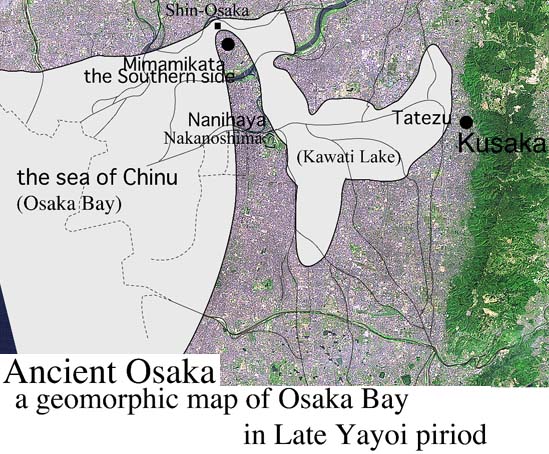
According to the Kojiki, they left Himuka( Hinata, Itoshima), progressed to eastward, and tried to colonize and dwell at Agi(Hiroshima) and Kibi(Okayama). But they made it badly, therefore they have to change their objects to invade the Bronze Bells Area. So they passed the Namihaya Crossing(Nakanoshima) of Osaka Bay, landed at Tatetsu of Kusaka. But they were defeated at the battle of Kusaka, and fled through Minami-kata(the Southern Side) Bay).
Then, they progressed round the Kii peninsula, made a shock attack to Yamato from Kumano over the mountains.
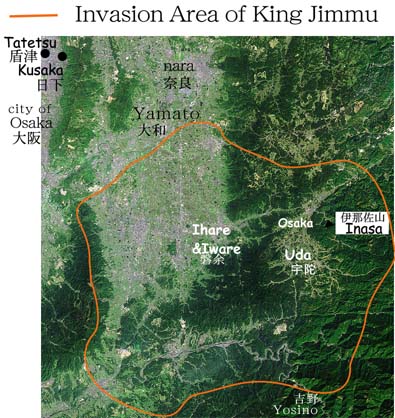
He ventured to invade eastern world, and succeeded in Yamato invasion. So he called "Kamu-Yamato Iware-Biko" in Yamato from Wa-states. Later he was called "Great King(Ohkimi)", or Jimmu Tenno. Jimmu Tenno was his posthumous name.
In Conclusion, King Jimmu is real. King Jimmu to Eastern Invasion has proved to be true by the geomorphic map of Osaka Bay in Late Yayoi period.
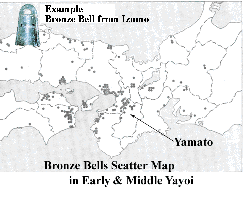
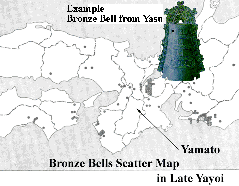
And the two Bronze Bells Scatter Maps, in Late Yayoi period and Early&Middle Yayoi period, has provide the another evidence. There is no Bronze Bell in Yamato in Late Yayoi period.
The birthplace of Jimmu implied in six Jimmu songs (Kume songs). In Yamato, they sang the songs of their native place Itoshima. He is a sea man rough and tough.
|
|
 |
|
|
 |
|
|
Song 1
This is a song that King Jimmu sang about the sea of Itoshima. There is no problem if he sings it in Itoshima, but it is impossible for him to sing it in Yamato for the first time. Because there is no sea in Yamato. There is a place name Uda in Yamato, but also is in Itoshima.
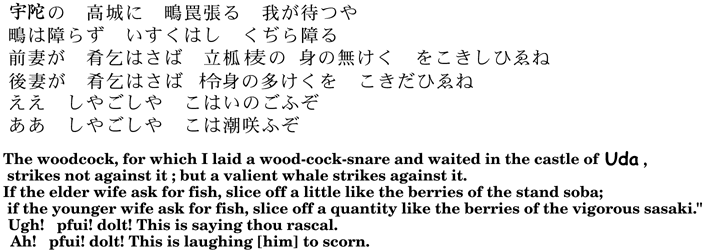
"The woodcock, for which I laid a wood-cock-snare and waited in the high castle of Uda, strikes not against it; but a valiant whale strikes against it. If the elder wife ask for fish, slice off a little like the berries of the stand soba; if the younger wife ask for fish, slice off a quantity like the berries of the vigorous sasaki."
"Ugh! pfui! dolt! This is saying thou rascal. Ah! pfui! dolt! This is laughing [him] to scorn."
Song 2
Adding the verse "smite and finish" to the song of children, they sang it in Yamato. Kume is a place name in Itoshima.
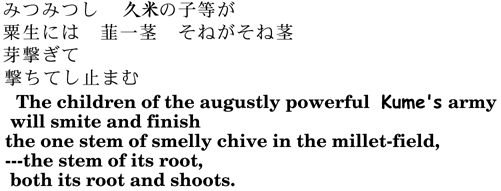
"The children of the augustly powerful Kume's army will smite and finish the one stem of smelly chive in the millet-field, ---the stem of its root, both its root and shoots."
Song 3
Again adding verse "smite and finish" to the song of children, they sang it in Yamato. Kume is a place name in Itoshima.
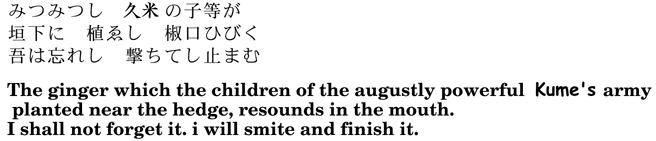
"The ginger which the children of the augustly powerful Kume's army planted near the hedge, resounds in the mouth. I shall not forget it. I will smite and finish it."
Song 4
And again adding verse "smite and finish" to the song of children, they sang it in Yamato. Kume, Oishi , Kamugase, and Ise are their native place names in Itoshima.

" Like the turbinidoe creeping round the great rock(Oishi) in the sea of Ise where is Kamugase (on wind which blows the divine), so will we creep round, and smite and finish them.�"
Song 5
Shima( island) is a place name in Itoshima. And Itoshima is a place of multiplication of cormorants(Japanese name is U). The name of Jimmu's father is U-gaya-fuki-aezu no Mikoto.
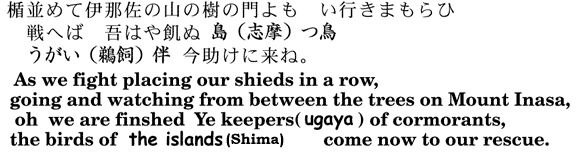
"As we fight placing our shields in a row, going and watching from between the trees on Mount Inasa, oh we are famished Ye keepers(ugaya) of cormorants, the birds of the islands(Shima) come now to our rescue. "
Song 6
Kume is a place name in Itoshima.
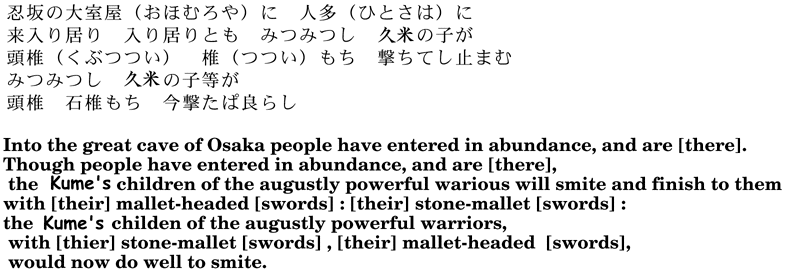
"�Into the great cave of Osaka people have entered in abundance, and are [there]. Though people have entered in abundance, and are [there], the Kume's children of the augustly powerful warriors will smite and finish to them with [their] mallet-headed [swords] : [their] stone-mallet [swords] : the Kume's children of the augustly powerful warriors, with [their] stone-mallet [swords] , [their] mallet-headed [swords], would now do well to smite. "
(Abridged and translated by Yukio Yokota)
The conventional opinions are as follows.
- 1.
THE CAMBRIDGE HISTORY OF JAPAN
VOLUME 1 ANCIENT JAPAN
- 2.
THE KOJIKI(Records of Ancient Matters)
- 3.
NIHONGI
Back to Home
Page
1.THE CAMBRIDGE HISTORY OF JAPAN
VOLUME 1 ANCIENT JAPAN
CAMBRIDGE UNIVERSITY PRESS 1993
GREAT WAVES OF CHANGE
Yayoi ferment(ca.300 B.C. to A.D.250)
Thousands of Yayoi period bronzes (mirrors, spears, swords, and bells) made
in China, or patterned after those that were, have been found at sites in widely
scattered regions of Japan. These bronzes were acquired, it is thought, by religiopolitical
rulers (Kings) who valued them as symbols of their power. Studies of the dating
and distribution of bronzes have enabled historians to see the outlines of change
in Japan's early relations with continental courts, to trace the course of political
centralization, and to appreciate a continuing preoccupation with sacral authority.
Although some of the early bronzes may have been used as weapons (especially
the swords called ka), most seem to have had little or no practical value. The
mirrors might have been used to see what could not be seen directly, but the
discovery that the backs of many were well worn suggests that they had been
hung around the necks of ritualists(shamans) as symbols of their mysterious
power. Such an interpretation is consistent with the prominence of mirrors in
later imperial myths and with the confirmed fact that sacred object of worship
(the shintai) at Japan's leading shrine (Ise) is a bronze mirror. The symbolic
character of bronze weapons is also underscored by the observation that many
are too big and clumsy for effective use as weapons. Furthermore, the bronze
bells often had no clappers, suggesting that they were not valued as articles
that could make marvelous sounds.
The distribution of Chinese bronzes found in Yayoi sites presents this puzzling
question: Why was no bronze bell included among the three sacred imperial symbols
(a mirror,a sword, and a jewel) of Yamato, the kingdom that arose in central
Japan where bronze bells have been found? For years, archaeologist have realized
that Yayoi period had two distinct cultural spheres: one in the west where large
numbers of bronze mirrors and weapons were accumulated, and another in central
and eastern regions where bronze bells where were prized. It is surmised that
the two spheres were linked with the continent differently: that whereas kingdoms
in the west were in touch with China and Korea through ports located along the
shores of Japan's southern island of Kyushu, those in the north and east were
in contact with the mainland through ports along the Japan Sea, probably as
far north and east as Noto peninsula. Because the predecessors of the Yamato
kings had come from the west (as ancient myths proclaim), they may well have
favored mirrors, swords, and spears - not bronze bells.
....
CHAPTER 1
THE EARLIEST SOCIETIES IN JAPAN
p48
Japan's oldest extant chronicles, the Kojiki and Nihon shoki, describe the trek of Kamu-yamato-ihare-biko no Mikoto from south Kyusyu to the Yamato plain accompanied by hand-chosen clan (uji) heads. He is referred to by later historian as the first emperor, posthumously called Jimmu. At every step he was opposed by well-entrenched people whose conquest often required ingenuity and guile. The degree of their decimation seems to have been determined by the degree of their physical abnormality. For the bulk of his adversaries, the killing of their chiefs was all that needed to bring them into line. But in extreme cases, such as the Tsuchigumo(earth spiders) who were people too primitive even to have responsive chiefs, pockets had to be eliminated by a process that was not completed until at least the time of the ruler Keiko, sometime in the fourth century A.D.
....
THE EARLIEST SOCIETIES IN JAPAN
Shamans and chieftains
P102
Events of Middle-to-Late Yayoi-reflected in the stories of the first emperor (Kamu-Yamato-ihare-biko no Mikoto, or Jimmu)-centered on the efforts of Yayoi chieftains to stake out claims to the best territory. According to the Nihon Shoki, Jimmu and his followers battled their way from South Kyusyu through the Inland Sea, overcome resistance in the Kibi Region, and, unable to penetrate the Kinki defenses around Osaka, skirted the peninsula and entered from the lightly occupied east to settle finally in the lower Nara basin.
At every step of the way, especially at the most hopeless moments, Jimmu is said to have sought the advice of the kami and, after performing sacrifices and practicing abstinence, fought successfully. The literature makes it unmistakably clear that there was a blind reliance on shamans and that a tribal leader served as a medium between his and people and the supernatural world. The Chinese accounts shamans and wars, the Japanese description of leaders pushing east into occupied areas, and Late Yayoi archaeological evidence of the rise of a power center in the Kinki all present a convincing picture of the emergence of a strong tribal group in that area during the second and third centuries A.D.
....
2.
THE KOJIKI(Records of Ancient Matters)
translated by Basil Hall Chamberlain
Charles E. Tuttle Company
V.2 (Middle Volume)
[SECT.XLIV.--- REIGN OF THE EMPEROR JIM-MU
(PART I. HIS PROGRESS EASTWARD, AND DEATH OF HIS ELDER BROTHER).]
The two Deities His Augustness Kamu-yamato-ihare-biko and his elder brother His Augustness Itsu-se, dwelling in the palace of Takachiho, took counsel, saying : "By dwelling in what place shall we [most] quietly carry on the government of the Empire? It were probably best to go east. " Forthwith they left Himuka on their progress to Tsukushi. So when they arrived at Usa in the Land of Toyo, ... Removing thence, they dwelt for one year at the palace of Wokoda in Tsukushi. Again making a progress up to from that Land, they dwelt seven years at the palace of Takeri in the land of Agi. Again removing, and making a progress up from that land, they dwelt eight years at the palace of Takashima in Kibi.
....
So when they went up from that land they passed the Namihaya Crossing, and brought up at the haven of Shirakata. At this time Nagasune-biko of Tomi raised an army, and waited to go out to fight [against them]. then they took the shields that had been put in the august vessel, and disembarked. So they called the name of Tate-dzu. It is what is now called the Tadetsu of Kusaka. Therefore when fighting with the Prince of Tomi, His Augustness Itsu-se was pierced in his august hand by the Prince of Tomi's hurtful arrow.
...
Having [thus] decided he, on making a progress round from the southern side, reached the sea of Chinu, and washed the blood on his august hand: so it is called the sea of Chinu.
[SECT.XLVII.--- EMPEROR JIM-MU (PART IV. THE UKASHI BRETHREN).]
....
So they forthwith pulled him out, and cut him in pieces. So the place is called
Uda-no-Chihara.
...
At this time he sang, saying:
"The woodcock, for which I laid a wood-cock-snare and waited in the high castle of of Uda, strikes not against it; but a valiant whale strikes against it. If the elder wife ask for fish, slice off a little like the berries of the stand soba; if the younger wife ask for fish, slice off a quantity like the berries of the vigorous sasaki."
....
[SECT.XLVIII.--- EMPEROR JIM-MU (PART V. THE EARTH SPIDER OF THE CAVE OF OSAKA).]
....
So the Song by which he made clear to them to set about smiting the earth-spiders
said:
"Into the great cave uf Osaka people have entered in abundance,and are [there],Though people have entered in abundance, and are [there], the children of the augustly powerful warriors will smite and finish to them with [their] mallet-headed [swords]: [their] stone-mallet [swords] : the children of the augustly powerful warriors, with [their] stone-mallet [swords] , [their] mallet-headed [swords], would now do well to smite." Having thus sung, they they drew their swords, and simultaneously smote them to death.
[SECT.XLVIX.--- EMPEROR JIM-MU (PART VI. THE PRINCE OF TOMI AND THE SHIKI BRETHREN).]
After this, when about to smite the Prince of Tomi, he sang, saying:
" The children of the augustly powerful army will smite and finish the one stem of smelly chive in the millet-field, ---the stem of its root, both its root and shoots."
Again he sang:
" The ginger which the children of the augustly powerful army planted near the hedge, resounds in the mouth. I shall not forget it. I will smite and finish it."
Again he sang, saying:
"Like the turbinidoe creeping round the great rock in the sea of Ise [on which blows] the divine wind, [so] will we creep round, and smite and finish them."
....
" As we fight placing our shields in a row, going and watching from between the trees on Mount Inasa, oh we are finished Ye keepers of cormorants, the birds of the islands, come now to our rescue. "
3. NIHONGI
Chronicles of Japan from the Earliest Times to A.D. 697
TRANSLATED FROM THE ORIGINAL CHINESE AND JAPANESE BY W.G. ASTON, C.M.G.
WITH AN INTRODUCTION TO THE NEW EDITION BY TERENCE BARROW, Ph.D.
CHARLES E. TUTTLE COMPANY Rutland Vermont & Tokyo, Japan
P109
BOOK 3
THE EMPEROR KAMI-YAMATO IHARE BIKO (JIMMU TENNO.)
The Emperor Kami Yamato Ihare-biko's personal name was Hiko-hoho-demi. He was the fourth child of Hiko-nagisa-take-u-gaya-fuki-ahezu no Mikoto. His mother's name was Tama-yori-hime, daughter of the Sea-God.
...
P112
The Imperial forces at length proceeded eastwards, the prow of one ship touching the stern of another. Just when they reached Cape Naniha they encountered a current of great swiftness. Whereupon that place was called Nami-haya (wave-swift) or Nami-hana (wave-flower). It is now called Naniha, which is a corruption of this.
3rd month,10th day. Proceeding upwards against the stream, they went straight on, and arrived at the port of Awokumo no Shira-date, in the township of Kusaka, in the province of Kafuchi.
...
P113
So he withdrew his forces, and the enemy also did not dare to attack to him. He then retired to the port of Kusaka, where he set up shields, and made a warlike show. Therefore the name of the port of this port was changed to Tatetsu, which is now corrupted into Tadetsu.
Before this, at the battle of Kusaka, there was a man who hid in a great tree, and by so doing escaped danger. So pointing to this tree, he said :- "I am grateful to it, as to my mother." Therefore the people of the day called that place Ono no ki no Mura.
...
P116
At this time Hi no Omi no Mikoto, ancestor of the Ohotomo House, taking with him Oho-kume as commander of the main body, guided by the direction taken by the crow, looked up to it and followed after, until at length they arrived at the district of Lower Uda. Therefore they named the place which they reached the village of Ukechi of Uda. ...
P118
The Emperor distributed this flesh and sake to the common soldiers, upon which
they sang the following verses :-
In the high castle(or tree) of Uda
I set a snare for woodcock,
And waited,
But no woodcock came to it;
a valiant whale came to it.
This is called a Kume song.
...
P122
The Emperor tasted the food of the Idzube, and arraying his troops set fourth upon his march. He first of all attacked the eighty bandits at Mount Kunimi, routed and slew them. It was in this campaign that the Emperor, fully resolved on victory, made these verses, saying :-
Like the Shitadami
Which creep around
The great rock
Of the sea of Ise
Where blows the divine wind--
Like the Shitadami,
My boy! my boy!
We will creep around,
And smite them utterly,
And smite them utterly.
In this poem, by the great rock is intended the Hill of Kunimi.
After this the band which remained was still numerous, and their disposition could not be fathomed. So the Emperor privately commanded Michi no Omi no Mikoto, saying :- "Do thou take with thee the Oho-kume, and make a great muro at the village of Osaka. Prepare a copious banquet, invite the enemy to it, and then capture them."
...
P123
Then Michi no Omi no Mikoto struck up the following song :-
At Osaka
In the great muro-house,
Though men in plenty
Enter and stay
We the glorious
Sons of warriors,
Wielding our mallet-headed,
Wielding our stone-mallet,
Will smite them utterly.
...
P126
Therefore the Emperor, to comfort the hearts of his leaders and men, stuck off
this verse :-
As we fight
Going forth and watching
From between the trees
Of Mount Inasa,
We are famished
Ya keepers of cormorants
(Birds of the islands)
Come now to our aid
...
P127
On this campaign it was his desire to put all to death, and therefore he composed
these verses, saying :-
My mouth tingles
With the ginger planted
At the bottom of the hedge
By the glorious
Song of warriors--
I cannot forget it ;
Let us smite them utterly.
Again he sang,saying :-
In the millet-field
Is one stem of odorous garlic :-
The glorious
Sons of warriors
Binding its stem
And binding its shoots
Will smite it utterly.
Then again letting loose his army, he suddenly attacked him. In general, all
these song composed by the Emperor are termed Kume uta, in allusion to the persons
who took and sang them.
We are waiting for your opinions and suggestions, please send E-mail to Yukio Yokota.
E-mail sinkodai@furutasigaku.jp
For Reference Link
Back to Home Page
Created & Maintained by"Yukio Yokota"
Copyrighted by"Takehiko Furuta"